
We can't find the internet
Attempting to reconnect
Back Go Rulebook Preview (Page 1 of 2)
GO RULES QUICK REFERENCE PT. 1
1. Basics.
The board starts empty. The board can be any size of grid, usually 13×13, 9×9 or 19×19. One player has black pieces and the other has white. The pieces are usually called stones. Black goes first, and then the players take turns. To make a play, you simply put a stone down on the board. The stones can only go on the corners of the squares, as shown in the pictures below. Once stones are played, they do not move.
2. Object of the game.
At the end of the game you score one point for each point of territory you have, and one point for each stone you have captured. You may also count by taking stones you have captured away from your opponent's territory. White gets an extra 7 points to make up for going second. The person with the most points wins.
3. Territory.
Here is the position at the end of a game. The points of white territory are marked with Ws. If you imagine moving from one of these points along the lines of the board, you will always come to the edge of the board or a white stone, never a black one. So you know that these empty points belong to White. Similarly the points of black territory are marked with Bs. White has 6 points of territory and Black has 3.
4. Liberties.
In order to see how to capture stones, you need to know about liberties and chains. The liberties of a stone are the empty points which are next to it. The white stone marked with a triangle has four liberties, each marked with an X. The points which are diagonally next to the stone do not count as liberties. The black stone marked with a triangle has only two liberties, marked Y. The other point next to it has been filled by a white stone.
Liberties are important, because if a stone runs out of them it will be captured!
5. Chains.
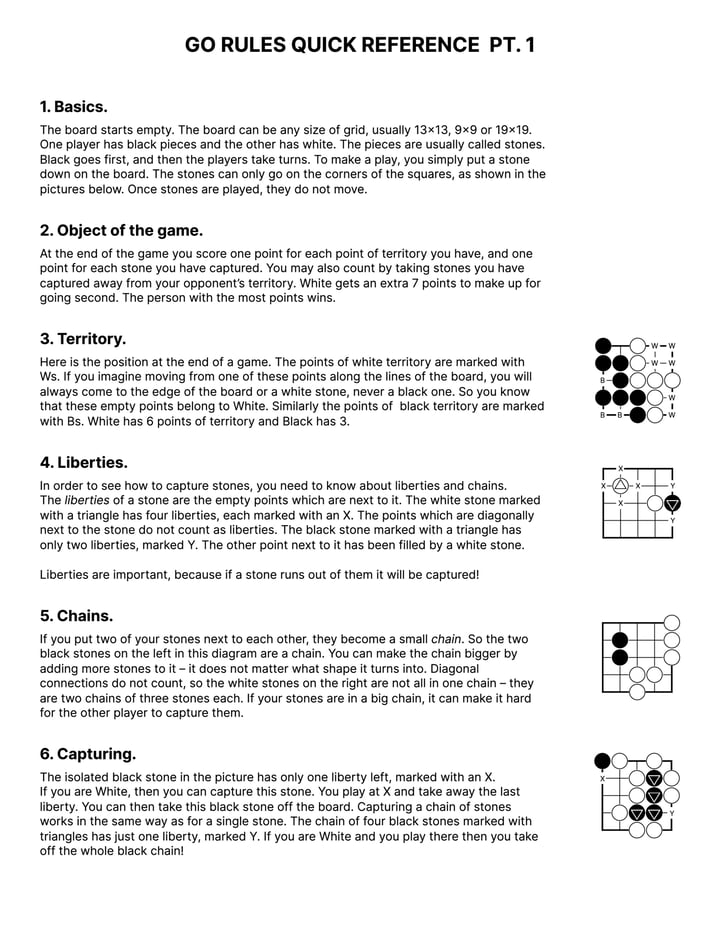
If you put two of your stones next to each other, they become a small chain. So the two black stones on the left in this diagram are a chain. You can make the chain bigger by adding more stones to it – it does not matter what shape it turns into. Diagonal connections do not count, so the white stones on the right are not all in one chain – they are two chains of three stones each. If your stones are in a big chain, it can make it hard for the other player to capture them.
6. Capturing.
The isolated black stone in the picture has only one liberty left, marked with an X. If you are White, then you can capture this stone. You play at X and take away the last liberty. You can then take this black stone off the board. Capturing a chain of stones works in the same way as for a single stone. The chain of four black stones marked with triangles has just one liberty, marked Y. If you are White and you play there then you take off the whole black chain!