We can't find the internet
Attempting to reconnect
Back Go Rulebook Preview (Page 2 of 2)
GO RULES QUICK REFERENCE PT. 2
7. More about capturing.
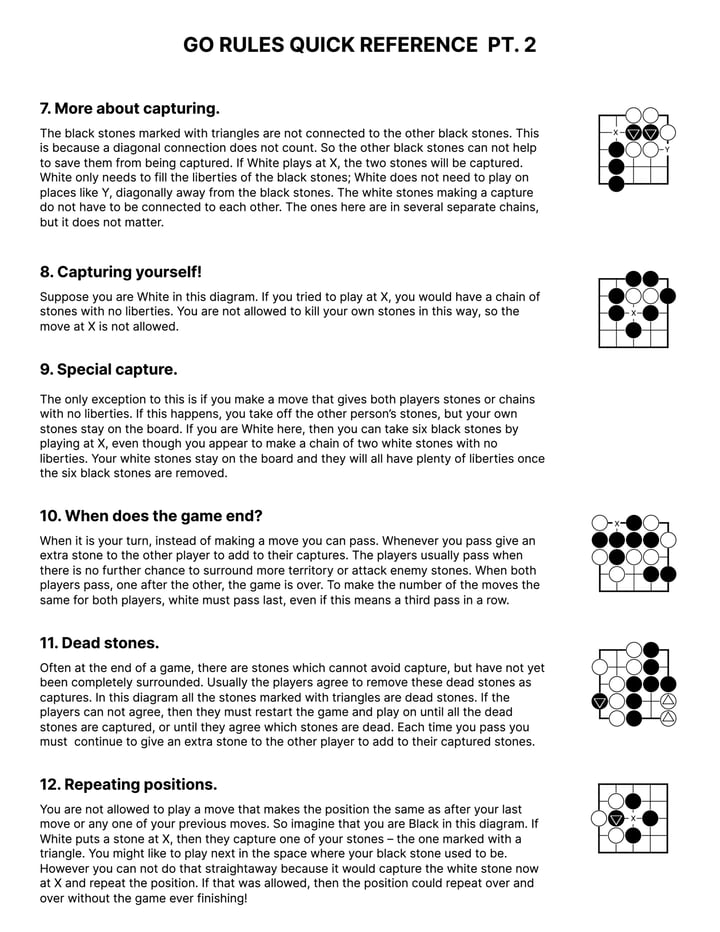
The black stones marked with triangles are not connected to the other black stones. This is because a diagonal connection does not count. So the other black stones can not help to save them from being captured. If White plays at X, the two stones will be captured. White only needs to fill the liberties of the black stones; White does not need to play on places like Y, diagonally away from the black stones. The white stones making a capture do not have to be connected to each other. The ones here are in several separate chains, but it does not matter.
8. Capturing yourself!
Suppose you are White in this diagram. If you tried to play at X, you would have a chain of stones with no liberties. You are not allowed to kill your own stones in this way, so the move at X is not allowed.
9. Special capture.
The only exception to this is if you make a move that gives both players stones or chains with no liberties. If this happens, you take off the other person's stones, but your own stones stay on the board. If you are White here, then you can take six black stones by playing at X, even though you appear to make a chain of two white stones with no liberties. Your white stones stay on the board and they will all have plenty of liberties once the six black stones are removed.
10. When does the game end?
When it is your turn, instead of making a move you can pass. Whenever you pass give an extra stone to the other player to add to their captures. The players usually pass when there is no further chance to surround more territory or attack enemy stones. When both players pass, one after the other, the game is over. To make the number of the moves the same for both players, white must pass last, even if this means a third pass in a row.
11. Dead stones.
Often at the end of a game, there are stones which cannot avoid capture, but have not yet been completely surrounded. Usually the players agree to remove these dead stones as captures. In this diagram all the stones marked with triangles are dead stones. If the players can not agree, then they must restart the game and play on until all the dead stones are captured, or until they agree which stones are dead. Each time you pass you must continue to give an extra stone to the other player to add to their captured stones.
12. Repeating positions.
You are not allowed to play a move that makes the position the same as after your last move or any one of your previous moves. So imagine that you are Black in this diagram. If White puts a stone at X, then they capture one of your stones – the one marked with a triangle. You might like to play next in the space where your black stone used to be. However you can not do that straightaway because it would capture the white stone now at X and repeat the position. If that was allowed, then the position could repeat over and over without the game ever finishing!